
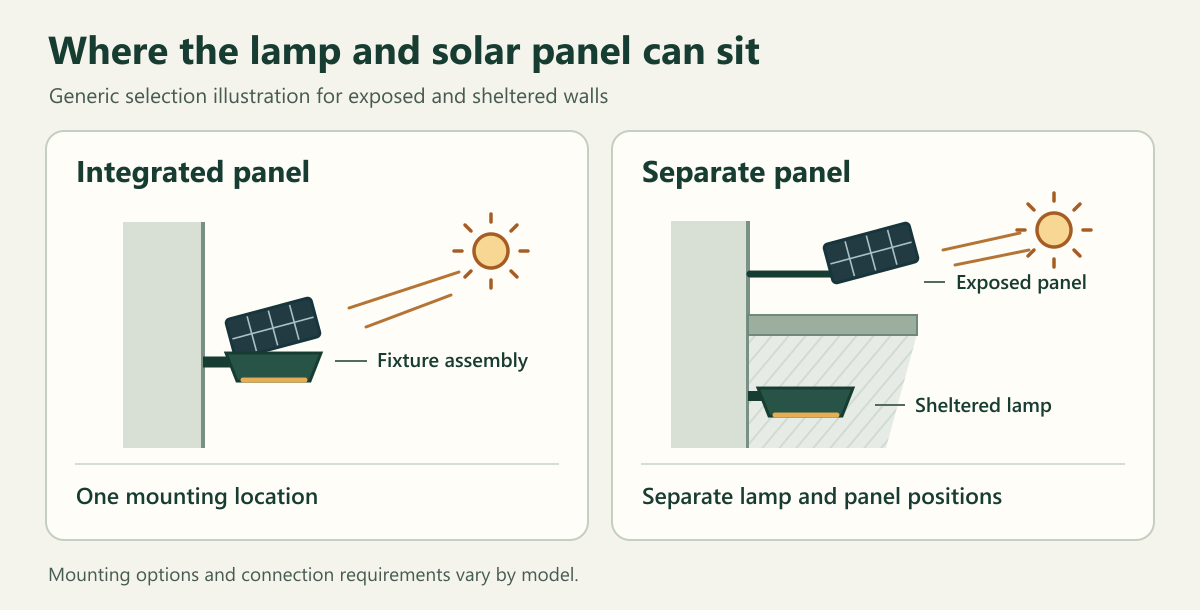
Shortlist an integrated solar wall light when one mounting location gives the panel usable daylight and lets the fixture light the area you need. If the best place for the lamp is shaded, consider a separate-panel model with an approved option to place the panel in a sunnier spot. If neither arrangement can meet the required lighting hours under representative conditions, revisit the location or consider another power source.
How the two designs differ
An integrated light carries the solar panel on the lamp assembly. The lamp and panel share one mounting location, so check both the light direction and panel exposure at that spot. A separate-panel light has a distinct panel assembly. Some configurations allow the panel to be mounted away from the lamp. Others keep the two parts close together. Ask which mounting arrangements the exact configuration supports before assuming a separate panel can be placed wherever it gets more sun.
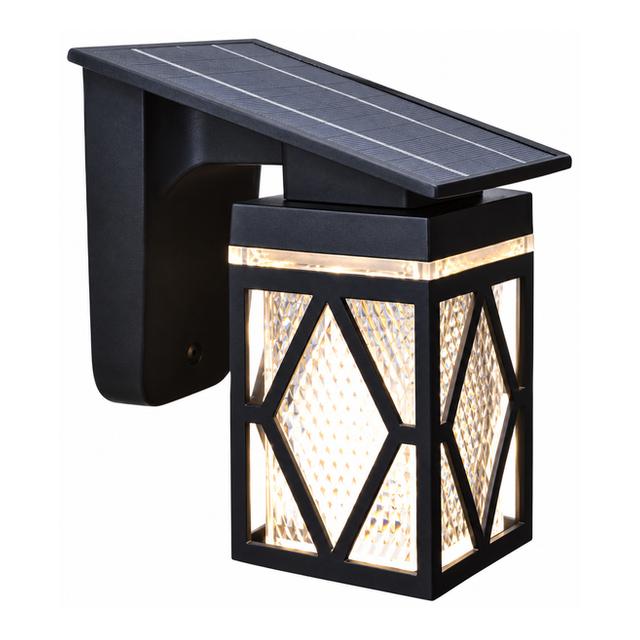
The LMV-F66-1 lantern pictured below has a panel built into the fixture.
The LMV-WL05 product page lists a separate panel. The usable mounting positions and included parts depend on the exact configuration and quotation.
Compare the listed specifications for four configurations
The table uses the listed specifications for each linked configuration. Compare panel ratings with panel ratings and check the pack voltage alongside battery capacity. The lamp column shows the type of information available for each SKU. The F66-1 LED count and WL05 lamp wattages describe different things and cannot establish which fixture delivers more light at the site.
| Configuration | Panel arrangement | Listed solar panel | Listed battery | Listed lamp specification |
|---|---|---|---|---|
| LMV-F66-1 | Integrated, diamond-grille wall lantern | 5 V, 2.8 W, monocrystalline silicon | 3.7 V, 3,600 mAh | 7 SMD LEDs. Lamp wattage is unspecified. |
| LMV-WL05-S-15W | Wall mount with separate panel | 5 V, 25 W | 3.2 V, 20 Ah | 15 W lamp rating |
| LMV-WL05-S-24W | Wall mount with separate panel | 5 V, 35 W | 3.2 V, 30 Ah | 24 W lamp rating |
| LMV-WL05-S-30W | Wall mount with separate panel | 5 V, 40 W | 3.2 V, 40 Ah | 30 W lamp rating |
The ratings are useful when matching the panel and battery to the quoted lamp. For example, the 35 W panel and 30 Ah battery belong to the listed 24 W configuration. A larger panel rating or battery capacity alone cannot establish the operating hours. For a comparison on that basis, ask for the operating mode, representative charging conditions and measured results for the selected SKU. Ask for comparable light output or distribution data if light coverage determines the choice.
Worked example: Two wall positions at one property
Consider a property with an exposed garden gate and a sheltered entrance. The gate needs enough light for people to find the latch and first part of the path. The entrance needs steady light on the threshold and approach until closing. The buyer must approve any panel or bracket visible on the front elevation. These are hypothetical project requirements, and the example does not describe a tested product.
| What to decide | Exposed garden gate | Sheltered entrance |
|---|---|---|
| What the site offers | The proposed lamp position has daylight exposure and faces the latch and path. | The eave shades the lamp position. A side wall appears to get better sun, and it may keep the panel out of the main approach view. |
| What to shortlist | Use LMV-F66-1 as an integrated example. Keep it on the shortlist if the same mounting position gives the panel daylight and lets the lantern light both target areas. | Use LMV-WL05-S-24W as a configuration to review if the supplier confirms the side-wall panel position is allowed. The 5 V, 35 W panel and 3.2 V, 30 Ah battery identify the version to request for the trial. |
| What to check before the trial | Confirm the fixture orientation, the daylight conditions at that spot and the mode the buyer expects to use. | Ask the supplier to confirm the allowed panel arrangement and list the panel, bracket and connection parts in the quote. Have the buyer check the panel and bracket from the entrance approach. |
| What passes | The trial fixture lights the latch and path, and it runs for the agreed hours in the agreed mode after representative site charging. | The panel position and visible hardware are accepted, the scope is documented, and the sample gives steady light on the threshold and approach until closing after representative site charging. |
| What to do if the result is short or unknown | If the sample lights the latch but misses the path, revise the fixture or position and repeat the trial. If the light coverage is good but the relevant charging conditions have yet to be assessed, keep runtime pending. | If the approved bracket or panel arrangement cannot be confirmed, hold approval and request the configuration details. If the buyer rejects the visible hardware, try another approved position or consider another power source. |
Treat the two locations as separate decisions. The gate sample may pass while the entrance remains pending. A bright courtyard gives little information about what the panel receives under an eave, and a trial in one season may leave a year-round requirement unresolved. Use the U.S. Department of Energy’s guidance on photovoltaic energy yield to understand why site conditions matter.
Compare samples on the same basis
Before the trial, write down the required area, lighting hours and mode for each location. During the trial, record the offered configuration, starting charge if known, charging conditions, operating mode and what remained lit until the end of the required period. If you compare supplier runtime figures, check that the starting charge, output and mode are comparable. The DOE Communities LEAP case study on solar street lighting discusses how location, season and required operating time affect a solar lighting project.
Review supply scope separately from sample performance. For a separate-panel configuration, confirm which panel, bracket and connection parts are included, separately priced or supplied by someone else. A working sample can establish performance while the order scope still needs written confirmation. For an option you intend to install, follow the separate-panel site checks to record panel position, shade and cable reach.
Buyer questions
Can I use a motion-mode runtime result for a continuously lit entrance?
Keep the continuous-light requirement open. Ask for a test in the steady mode and at the output you plan to use, with starting charge and charging conditions recorded. A motion-mode trial can help if you also have a location where that mode meets the brief.
Can I mount an integrated light on a brighter side wall and aim it toward the entrance?
Only if the model permits that orientation and the resulting beam still covers the required area. Ask how the panel and lamp can be oriented and trial the new position from the normal approach. Recheck both the threshold and any nearby viewpoints where glare could become a problem.
What if a bright-weather sample passes but the entrance needs light through winter?
Record the bright-weather result and keep winter runtime pending. Review the lower-light season at the proposed panel position and ask for evidence for the same configuration and lighting schedule under relevant conditions. If the evidence is unavailable and the schedule is essential, compare a different location or power source before committing.
Can I replace the separate panel without replacing the lamp?
That depends on the exact configuration. Ask for the compatible replacement part and whether the manufacturer treats replacement as field service or a supplier service job. If serviceability matters to the purchase, confirm part availability and the service route before approving the configuration.
Can I approve a sample that arrived with a different bracket from the one quoted?
Keep mounting and order-scope approval open. Ask the supplier to identify both brackets and confirm which will ship. If the production bracket changes the panel position, clearances or appearance, verify those points using the production bracket before approving it.
Related wall lights
The Solar Globe Wall Light and Cylindrical Solar Wall Lantern offer other fixture styles. Check each configuration's panel arrangement and mounting options when you shortlist it.
Request a configuration review
Browse the outdoor wall lighting range and ask LUMELVO about fixture options for your wall. Share the wall positions, where the light needs to reach, the required operating mode and hours, and any restrictions on visible hardware.