
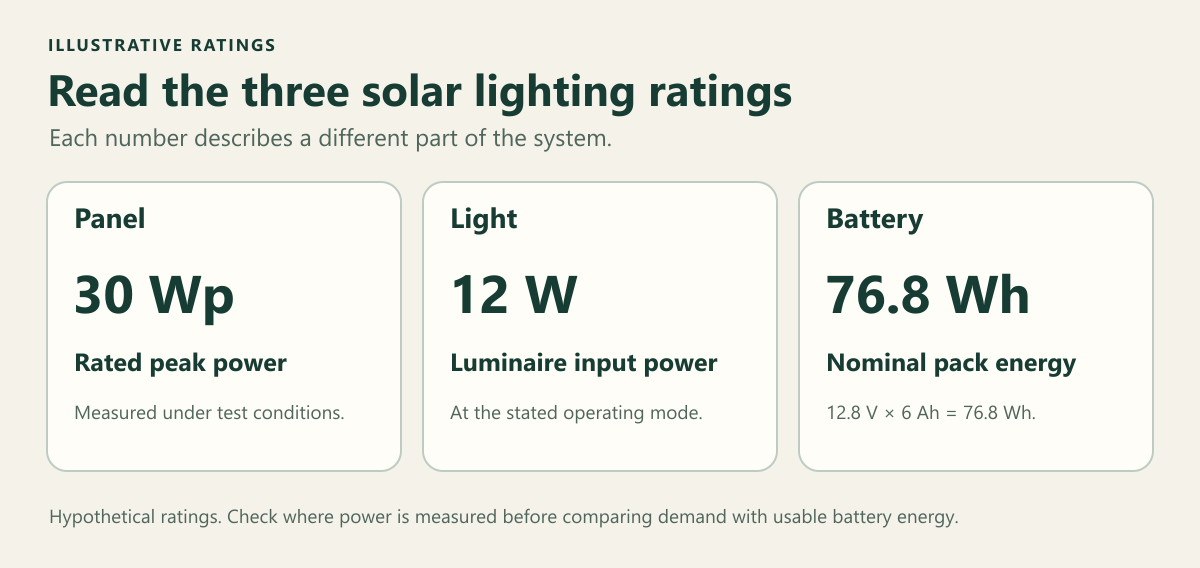
A solar light can list a 30 Wp panel, a 12 W light and a 76.8 Wh battery on the same specification sheet. Each number describes a different part of the system. The panel rating describes peak power under test conditions. The light rating describes power at a stated operating point. The battery figure describes nominal stored energy. To judge whether the light can run on your schedule, compare the energy available from the battery with the energy the system draws over that schedule. Both figures need to refer to the same configuration, measurement boundary and operating conditions.
What each rating tells you
| Field on the spec sheet | What it measures | What to ask |
|---|---|---|
| Solar panel peak power, Wp | Rated panel power under standard test conditions | Which panel is fitted, and what conditions apply to its rating? |
| LED or luminaire power, W | Power at a stated operating point | Does the figure refer to the LED module or the whole luminaire? Where was it measured, and in which mode? |
| Battery energy, Wh | Stored energy as stated by the supplier | Is it nominal or usable energy? If usable, what were the test conditions and cutoff? |
| Battery capacity, Ah | Electric charge capacity | What is the nominal voltage of the same pack, and under what conditions was capacity rated? |
The panel's Wp rating gives you a starting point for comparing panels. It cannot tell you how much energy the battery receives on a given day. Sun exposure, orientation, shade and temperature all affect what the panel can deliver. The U.S. Department of Energy guidance on photovoltaic performance explains how site and operating conditions affect performance.
Convert battery amp-hours using the pack voltage
Multiply the nominal voltage of the assembled pack by its amp-hour rating to estimate nominal watt-hours. A hypothetical 12.8 V, 6 Ah pack has 76.8 Wh of nominal energy. Use the voltage that belongs to that pack. A panel voltage or the voltage of a single cell gives the wrong result unless it is also the actual nominal voltage of the battery pack being rated.
Usable energy depends on how far the system allows the battery to discharge, as well as temperature, battery condition and the load applied during the test. Ask the supplier for the usable energy of the offered pack with its controller and cutoff. The U.S. Department of Energy reference on battery capacity and discharge conditions provides background on why discharge rate, temperature and cutoff matter when reading a battery rating.
Use watt-hours to read an operating schedule
Read two catalog configurations without mixing their ratings
| Catalog configuration | Listed solar panel | Listed lamp power | Listed battery and calculated nominal energy |
|---|---|---|---|
| LMV-RD01-S-12W | 5 V, 25 W | 12 W lamp rating | 3.2 V × 20 Ah = 64 Wh nominal |
| LMV-CPD1102-10M-S-WHITE | 5 V, 11 W | Input power unspecified for the 10 m white rope | 3.2 V × 10 Ah = 32 Wh nominal |
For RD01, ask whether the listed lamp rating represents input at the point where you will measure energy, and which mode it describes. For CPD1102, request the input power of the complete 10 m rope in the mode to be tested before calculating an operating schedule. In both cases, the nominal Wh calculation identifies the pack. Ask for usable Wh and a measured load profile if you need to determine runtime. These are different applications and the figures serve to explain how to read the specifications.
Calculate an example schedule at the luminaire input
Suppose a hypothetical light draws 12 W at the luminaire input for four hours, then 4 W at that same point for two hours. The first period uses 48 Wh and the second uses 8 Wh, for a total of 56 Wh at the luminaire input. This example uses an assumed operating profile independent of the catalog configurations above. The U.S. Department of Energy guidance on LED dimming and lighting controls gives context for using different output levels within a schedule.
Worked example: Decide what the supplier's reply establishes
Read each row below as a possible reply about the same hypothetical configuration. The job is to decide whether the six-hour schedule is supported under the stated test conditions. Daily recharging is a separate check.
| Supplier reply | What you can conclude | What to do next |
|---|---|---|
| “76.8 Wh battery.” | This is the nominal pack figure. Comparing it with 56 Wh at the luminaire input gives no pass result. | Ask for usable energy and the full system's demand at the battery terminals for the six-hour schedule. |
| “66 Wh usable.” The supplier omits the cutoff, temperature and load. | The usable figure lacks the conditions needed for comparison. The 56 Wh figure still comes from a different measurement point. | Ask how usable energy was measured and which controller cutoff applied. Request battery-terminal demand for the same schedule and conditions. |
| “66 Wh usable and 61 Wh drawn at the battery terminals for the full system.” Both figures refer to the same sample, starting charge, cutoff and conditions. The recorded run maintains the requested output in both modes. | The recorded sample covers this schedule under those test conditions, with a 5 Wh difference. | Record the test conditions and compare that difference with any project reserve requirement. Check separately whether the panel can restore the energy between runs at the site. |
If the supplier can only provide luminaire-input data, ask which controller loads and conversion losses sit upstream of that point. If the supplier measured the full system at the battery terminals, that result already includes the upstream loads and losses active during the run. Keep the measurement point on each number when reviewing street and area lighting configurations, and check that the panel, light and battery values belong to the same offered configuration.
Specification questions
What if a listing simply says “60 W solar light”?
Ask what the 60 W label refers to before using it in a calculation. Request separate panel, luminaire and battery ratings. If it refers to the light, ask whether it is measured input power in a named mode or a nominal LED rating.
How do I account for a motion sensor in an energy estimate?
Count standby and triggered operation as separate periods. Get power readings at the same measurement point, and record how many triggers you expect and how long each trigger lasts. Use the actual accumulated time in each mode, since a new trigger may extend an existing on period.
Can I use a meter that logs only Ah to verify watt-hours during a trial?
Use a meter that records Wh at the agreed measurement point if the test requires measured energy. Multiplying logged Ah by nominal voltage gives an estimate. When voltage changes during the run, ask for energy measured from voltage and current over the full schedule.
Two suppliers claim ten hours of runtime. What makes those claims comparable?
Ask for the output and mode over the full ten hours, including any automatic step-downs. Check the starting charge, temperature, cutoff and the criterion for ending the test. If one light dims after two hours and the other holds the required output, the two figures describe different results for a buyer who needs that output throughout.
Does doubling panel Wp halve charging time?
Do not use that ratio as a charging estimate. Check how much of the panel output the controller can accept, the starting battery charge and the daylight exposure available at the site. Request charging data for the actual panel, controller and battery combination when recharge time is a purchase condition.
Related products
Use the Swan Solar Street Light and Solar LED Rope Light pages as starting points for checking individual configurations. Keep the power and energy figures tied to the exact configuration you are reviewing.
Review the configuration as a set
Send LUMELVO the specification fields you want to clarify. Include the configuration reference, required operating schedule and any figures whose measurement point or test conditions are unclear.