
A useful outdoor lighting request for quotation (RFQ) lets you compare the same configuration and supply scope across suppliers. Send a short project brief and one line per configuration. Ask suppliers to reply against your line IDs and state what they included, excluded or priced separately. Before you rank quotes, close any open item that could change the fixture, price or delivery date.
Start with a one-page brief
State the destination market, intended use, estimated quantities and required delivery window. Include the requested trade term, named place and quote currency when known. For a project, attach the drawing revision that governs the installation, with the relevant location or mounting point marked. For stock purchases, describe the intended applications and any requirements the range must meet.
Separate requirements from preferences. An existing base may fix the mounting footprint, while the finish may be open to alternatives. If a requirement calls for a drawing, declaration or test report, state what the document needs to cover. The U.S. Department of Energy’s exterior-lighting acquisition guidance illustrates how a buyer can specify fixture categories and technical criteria. Use the requirements that apply to your project and destination market.
Give each configuration its own line
| RFQ field | What the buyer should send |
|---|---|
| Line ID and quantity | One ID for each configuration, with the base quantity and any optional quantity tier. |
| Fixture and intended use | Fixture type, installation location or application, and a model reference or marked image if available. |
| Mounting and power | Known mounting constraints, drawing revision and confirmed power supply. Mark unresolved inputs explicitly. |
| Performance and finish | Required output or light distribution, operating mode, finish and color where they affect selection. Identify which items are preferences. |
| Supply scope | List relevant parts, such as the head, pole, bracket, mounting plate, anchors, controls, panel or battery. Specify any items that need a separate price. |
| Evidence and commercial terms | Name the documents, labels or packaging required. Ask for the exact offered configuration, unit price and currency, lead time and the event that starts it. |
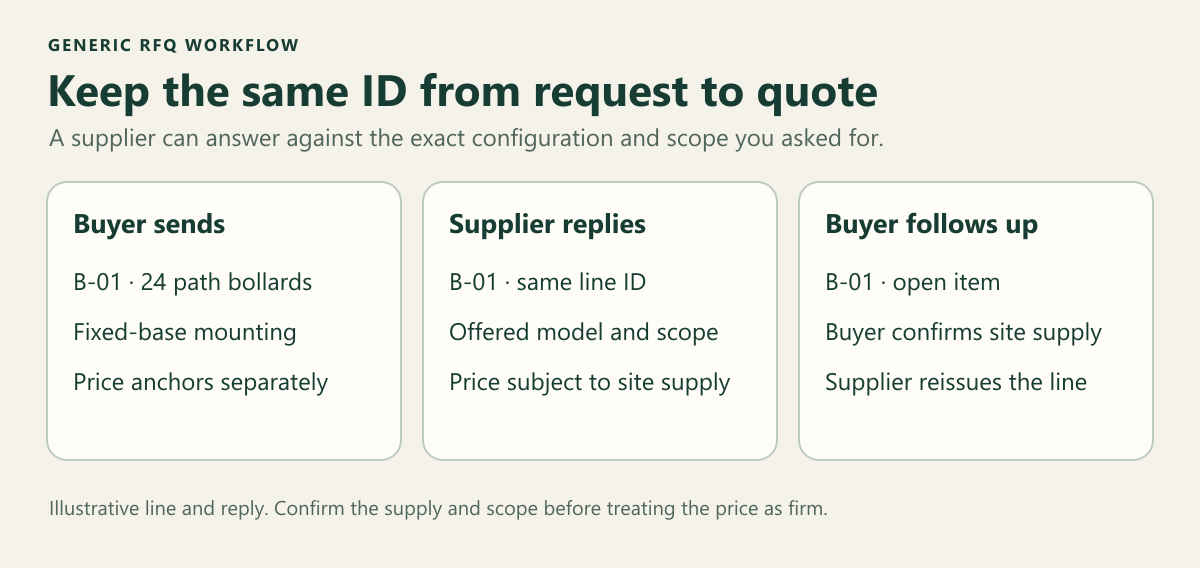
Worked example: Two quotes for the same bollard line
The buyer needs 24 fixed-base path bollards for a landscaped walkway. Line B-01 references the marked base drawing, requests the fixture and mounting plate, and asks for anchors to be priced separately. The site team has yet to confirm the electrical supply. Both supplier replies below are hypothetical. The prices are in USD per unit at the same stated quantity and delivery basis, so the differences in scope and configuration are easier to see.
| Check | Supplier A | Supplier B |
|---|---|---|
| Fixture and power | Offers a mains-powered configuration on an assumed site supply. | Offers a solar configuration as a substitute. It changes the power approach, so the buyer must review it separately. |
| Fixture and mounting plate | USD 84 per unit. Both are listed as included. | USD 78 per unit for the fixture. The required plate is USD 12 extra. |
| Anchors | USD 6 per fixture as a separate option. | Excluded, with no price or anchor schedule provided. |
| Comparable subtotal | USD 84 per unit for the fixture and plate, subject to the power assumption. | USD 90 per unit for the fixture and plate, subject to review of the solar substitute. |
Supplier B’s USD 78 headline price covers less than the requested scope. Adding the plate brings it to USD 90 per unit. Even after that adjustment, keep the award on hold. Supplier A has priced an unconfirmed supply, and Supplier B has proposed a different power approach. If the buyer needs supplier-provided anchors, Supplier B’s anchor exclusion is another open item.
What closes the line. The site team confirms the available supply and the mounting footprint. The buyer then asks both suppliers to reissue B-01 against the same confirmed requirement, showing the exact offered configuration, the fixture-and-plate price and the anchor option. If the buyer wants to evaluate solar, record it as a separate alternate with its own acceptance conditions. Treat B-01 as ready to compare when both replies cover the confirmed requirement and requested scope on the same commercial basis. If a revised reply still carries a power assumption or an unresolved scope item, keep it provisional and name who must close it.
Use the catalog SKU to define the requested scope
Add the exact configuration to each real RFQ line and ask the supplier to identify any substitute explicitly. The examples below show how catalog fields can become questions for the quotation. Keep the hypothetical B-01 replies above separate from these product references.
| Catalog configuration | What to carry into the RFQ | What to confirm on the quoted line |
|---|---|---|
| LMV-RD01-S-12W | Solar light head listed at 12 W for post or bracket mounting. Specify whether the project already has a support. | Identify the included light head, solar assembly and bracket. State who supplies the pole and foundation. |
| LMV-P180-1 | Wall-mounted configuration, listed at 180 × 218 mm. Use the full suffix on the RFQ. | Confirm the mounting footprint, required hardware and which components are included or quoted separately. |
RFQ questions
Can I request a quote with only a reference photo?
Yes, for a preliminary quote. Mark what the photo is meant to show, such as the mounting style or finish. If the fixture must fit an existing base, send the base measurements or a marked drawing before accepting a fit claim. Ask the supplier to identify the exact configuration it proposes and flag visible differences from the reference.
How should I request prices when the final quantity is unknown?
Ask for price tiers against the same configuration and scope. Show the expected production quantity separately from the sample quantity. If different tiers assume different packaging or delivery terms, ask for those differences to be stated alongside the price.
What if the drawing and the RFQ line disagree?
Hold that line until the buyer identifies which requirement governs. Give suppliers the corrected drawing revision and a written clarification under the original line ID. Ask them to confirm whether the correction changes the offered configuration, price or lead time.
Can I compare two quotes that both say “30 days”?
Only after you confirm when the clock starts and what happens at the end. One quote may count from deposit and end when goods are ready at the factory. Another may count from sample approval and end at shipment. Ask both suppliers to identify those events and state any buyer approvals that affect the schedule.
What if the report names a product family rather than the offered model?
Keep the evidence item open until the supplier shows that the offered configuration is covered. Ask for the exact model and variant, the report reference and the document section or variant schedule that connects the two. If the supplier cannot show that connection, record the evidence as outstanding before you approve the line.
Send your brief and item list
The outdoor lighting services overview explains the available inquiry routes. Share your RFQ with LUMELVO and include the destination, quantities, required scope, applicable drawing revisions and any open items that could change the quote.